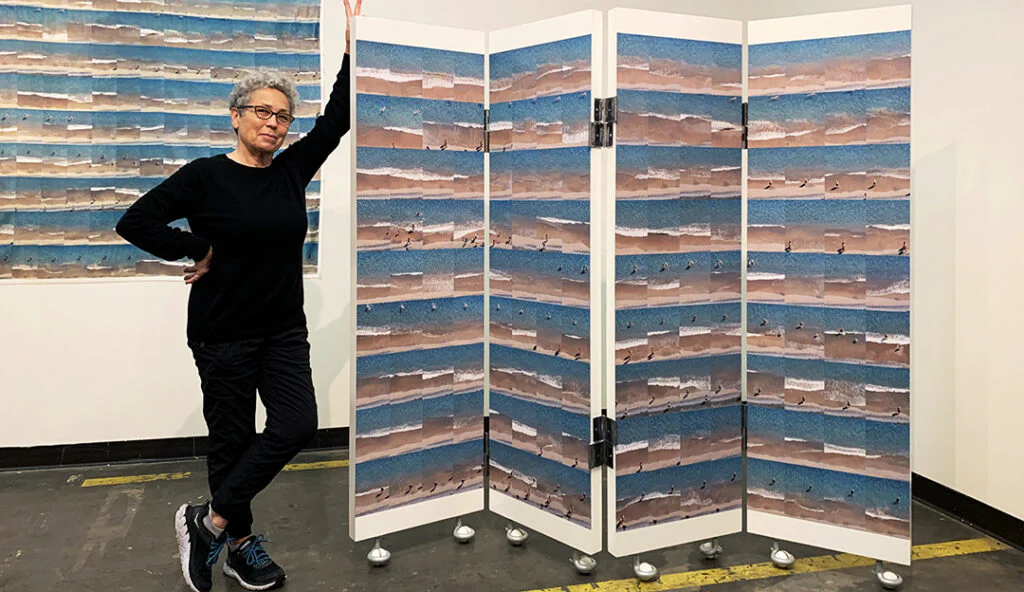
*photo courtesy Trish Tunney
Serial photographer
Ever since I can remember I have approached reality through multiple perspectives. It has always been difficult for me to choose a single image to capture the essence of a subject – whether a tree, a dancer, a city, the ocean. What better way to get close to something than to move across the details of its surface, clicking selectively, collecting intimate visual data? Each sequence represents the original movement of the camera. As in film, the sequences follow the rhythm of discovery, connecting discontinuous images through the movements of the eye behind the camera. The sequences – every image is different – can then be accumulated and composed to create a larger statement. And soon, within this dynamic repetition, rhythms and patterns start to emerge. The ensuing grid structure imposes a kind of order on reality’s many chaotic forms, altering the work’s perception whether seen from a distance, or from up close. Sequential photography allows me to work on a large scale and to combine painterly elements with a sculptural format. The compositions become interactive, rhythmic and meditative, providing a glimpse of the infinite within the physical world. Observe the writing of water on sand, the pattern of bark on a tree, a building’s glass façade, the shimmer of cloth, the veins in a leaf; experience a different perception of time, not presented in a seamless flow, but as time broken down into moments, captured one after the other.
Some of the Parts
Thoughts on the Works of Simo Neri – Richard Ingersoll, April, 2005 – […] The sum of the parts is in effect only some of the parts. Yet this method evokes a greater whole that can be identified as the resonance between the viewer and the phenomenon. As research these works push provocatively on the “doors of perception“. They are precise and objective portrayals of fragments of reality that deny the possibility of seeing objects in space in their three-dimensional integrity. Photography has been used to countermine its own determinedly scopic nature to see things from a different, multiple point of view. Each shot provides a piece of space, but taken together they do not lead to a literal reconstruction of a setting. At the same time that space has been negated, the more ambitious works that hang free-standing propose a basic contradiction: they are installed as spatial definers, shaping the interior environment.